Catherine Chen & Sara Woldehanna: Building Survivor-Centered AI
Written by the Patrick J. McGovern Foundation team.
Meet the leaders who are putting AI to work for good. Humans of AI for Humanity is a joint content series from the Patrick J. McGovern Foundation and Fast Forward. Each month, we highlight experts, builders, and thought leaders using AI to create a human-centered future — and the stories behind their work.
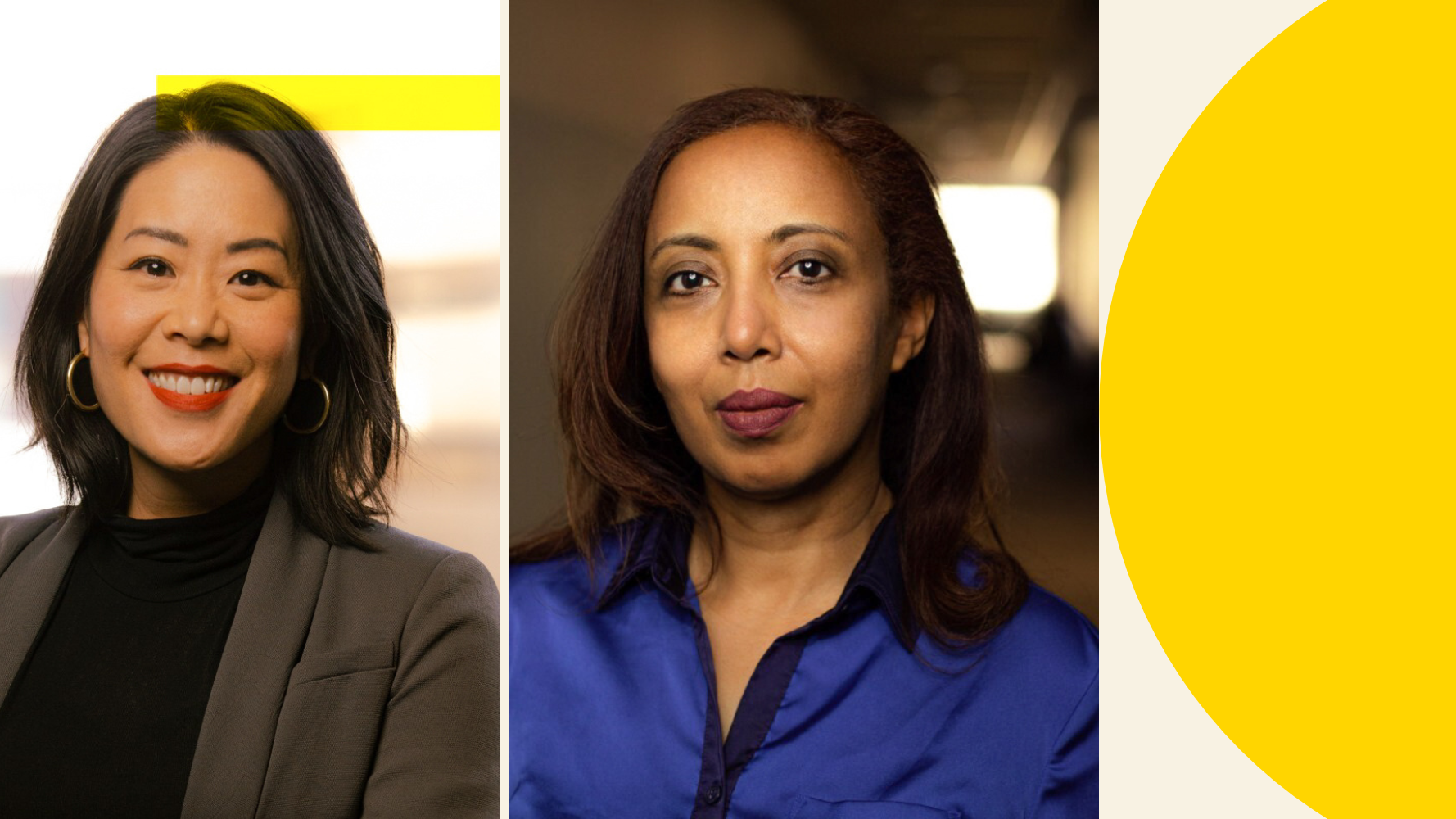
Catherine Chen and Sara Woldehanna share a unique vision for AI: one in which the technology protects, uplifts, and empowers survivors of all forms of injustice, exploitation, and abuse. Their vision is more than just a dream. It’s a testament to what’s possible, as influenced by their shared victories as the CEO and Managing Director of Data, Strategy, and Impact at Polaris, a nonprofit working to end sex and labor trafficking in North America.
Driven by the courage and resilience of survivors, Chen and Woldehanna are laying the foundations for a new paradigm of survivor-centric innovation, rooted in principles of co-design, empathy, and human dignity. Part of this effort includes the largest study on trafficking survivors to date — a project that continues to inform the fight for justice today. Woldehanna is now leading the development of new machine learning and AI-driven pilots to inform the organization’s ongoing advocacy efforts. This next phase of their work will focus on both finding effective solutions and setting contextually relevant standards for leveraging AI in the anti-trafficking space while mitigating the unique risks.
Soon, Chen will transition out of her role as CEO at Polaris. As she contemplates the next step in her lifelong fight for human rights, she looks forward to continuing to champion the efforts of Woldehanna and her team. In advance of Chen’s departure, we spoke with both women to learn more about the people behind Polaris’ impact.
How did your journey inspire you to explore AI for humanity?
Catherine: Growing up in a Chinese immigrant family, I understood that people in my own community were often exploited, harassed, and abused as low-wage workers in jobs that were dirty, demeaning, or dangerous. I found my calling to fight this kind of exploitation at the same time that the anti-human trafficking field was being defined around the world, an event that brought newfound clarity to the dynamics I saw impacting my community. As a result, I started doing this work before there were good, proven solutions, and very few definitions or frameworks. So I have a strong belief that with the right intentions and support, any new tool (like AI) can be useful toward achieving the ultimate goal of ending human trafficking and the suffering that comes with it.
I am also delighted to be doing this series with my colleague, Sara Woldehanna, who leads Polaris’s data and strategy efforts and has been the brilliant mastermind behind the work we do.
You work with a population that is often “invisible” to first responders, public authorities, and advocates. How have you seen AI and data solutions create pathways to reach survivors of human trafficking so that you can provide services sooner, while protecting their privacy and security?
Catherine: Trafficking is not easy to identify, in great part because traffickers use coercion and fraud to control victims. People who are targeted by traffickers often have complex needs and histories of trauma that are then exploited by traffickers. We use data solutions as a tool to understand trends, so that we are able to better respond and partner with a wide range of stakeholders. We want to ensure that our highly skilled staff can leverage data and technology to do what they do best — use their humanity to understand a very dynamic and complex situation and make wise judgments about what to do next.
Source: Polaris National Survivor Study

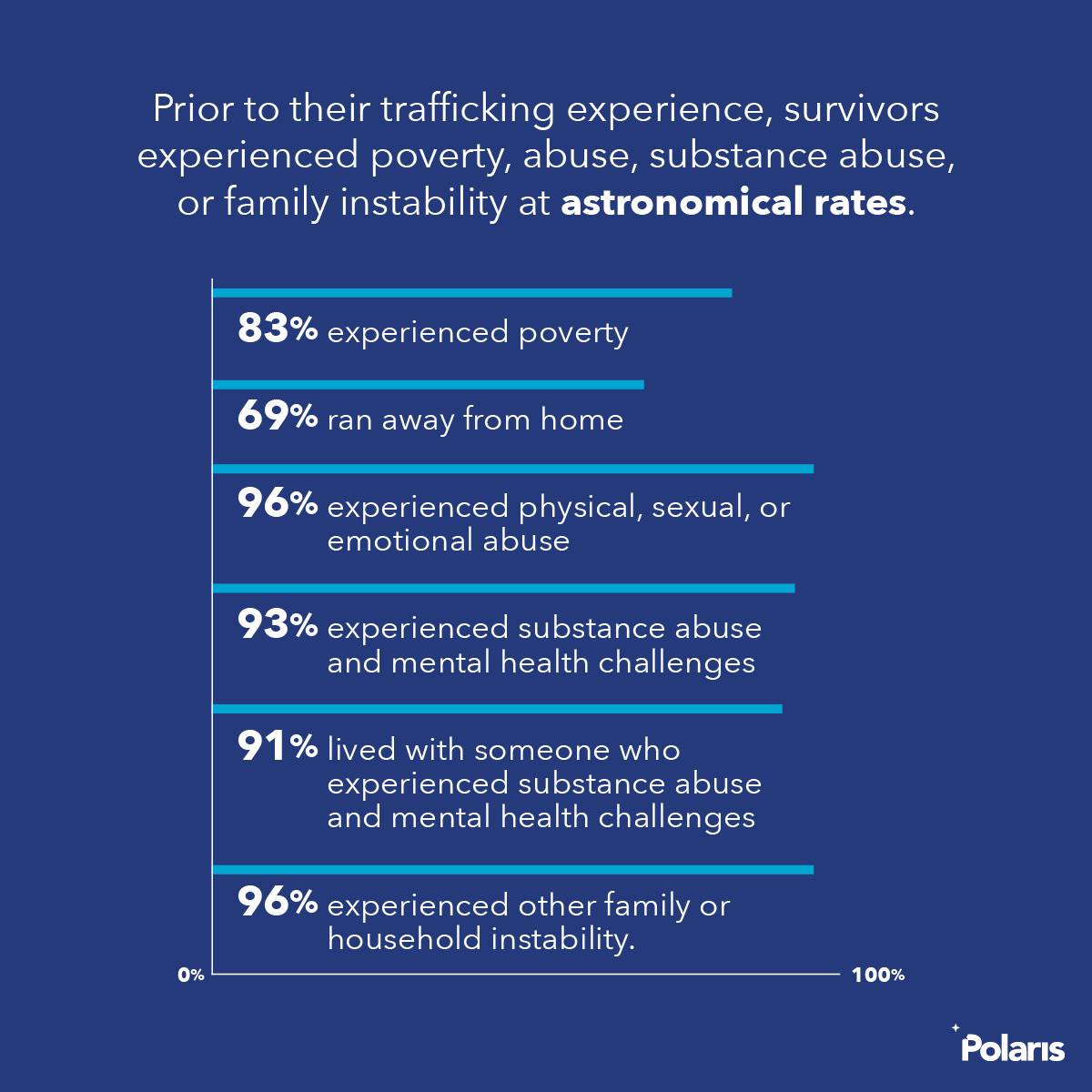
Sara: At Polaris, I’ve witnessed firsthand just how effective technology can be as a tool to reach survivors. Three years ago, we identified a critical gap in data about the needs of trafficking survivors, leading to the creation of the National Survivor Study (NSS). This survivor-centered, justice-driven data initiative has become a model for gathering impactful insights via technology while safeguarding survivors' privacy and security.
Co-designed with survivors to ensure that their perspectives shaped the research, the NSS also engaged anti-trafficking stakeholders, industry leaders, and technology partners. Together, we built a robust infrastructure, including custom survey tools, secure phone banks, discreet payment systems, and advanced data analysis capabilities.
Since its inception, the NSS has uncovered hidden challenges survivors face after trafficking, such as barriers to mental health care, the stigma of criminal records, and limited pathways to sustainable livelihoods. These findings have informed targeted, comprehensive solutions through partnerships with policymakers and industry leaders. By leveraging technology and data, the NSS has also accelerated system-wide interventions and fostered a deeper understanding of respectful, impactful engagement with survivors.
At Polaris, we treat innovation as a collaborative process, combining the right tools, talent, and partnerships. We also embrace experimentation and iteration, recognizing that progress comes from learning through both successes and failures.Sara Woldehanna, Managing Director of Data, Strategy and Impact, Polaris
Polaris fights to protect and restore the human rights of trafficking survivors, many of whom already come from historically marginalized backgrounds. What lessons or best practices guide your approach to leveraging technology in support of a population that may fear or mistrust it?
Sara: Our exploration of technology to transform our work is guided by transparency, ethical design, and collaboration. We prioritize open communication to build trust, clarify technology’s capabilities, and engage stakeholders. We also rely on human-in-the-loop design to ensure that our tools are supporting human expertise while prioritizing shared values and tangible benefits for survivors. To address potential biases, we apply rigorous checks, validate outputs, and set realistic expectations.
At Polaris, we treat innovation as a collaborative process, combining the right tools, talent, and partnerships. We also embrace experimentation and iteration, recognizing that progress comes from learning through both successes and failures. While we have not yet implemented AI solutions in direct victim-facing work or any of our data collection, our pilots have helped us build expertise and lay the foundation for thoughtfully and carefully integrating it in the future.
I want to see an AI future that enables us to be our better selves — more empathetic and compassionate, more understanding and tolerant, and more inclusive of one another.Catherine Chen, Chief Executive Officer, Polaris
Which visionary leaders, philosophies, or movements give you hope for a more human-centered AI future?
Catherine: Honestly, amazing women like Sara give me hope. Additionally, the many survivor leaders and advocates we work with at Polaris give me hope for a more grounded and inclusive future. I love that we are in a period of time where people with proximate and lived experiences are increasingly centered and valued in the work that we all do.
That’s the ethos that drives our work at Polaris. We believe that those with lived experience of being a trafficking victim should be at the center of our work. Sara has led a research team that has taken this principle and done so much with it through the National Survivor Study — we hired survivors to inform, interpret, and analyze, but we also continue to look to them as thought partners on how to balance the tension between our desire to find answers and the risks some of that exploration might unearth.
After four years of serving as Polaris’s CEO, over two decades of fighting for the rights of trafficking survivors, and countless breakthroughs in the name of justice, you will be embarking on a new journey. What are you most looking forward to in this next phase of your career?
Catherine: A few years ago, a wise friend told me to read Tricia Hershey’s "Rest is Resistance." In it, she asserts that “[rest], in its simplest form, becomes an act of resistance and a reclaiming of power because it asserts our most basic humanity. We are enough.” That is a radical idea for a chronic doer like me, and I have found it liberating to just be enough without a title or an agenda. So I am looking forward to some real respite to rediscover what inspires me, delights me, and gives me hope — even through the tough times ahead. And then, once I’ve had some time off, I’m looking forward to embracing whatever comes next in our collective fight for equity and justice.
Stay tuned for next month’s Humans of AI for Humanity blog, featuring Tarjimly co-founder Atif Javed.
For more on AI for good, subscribe to Fast Forward’s AI for Humanity newsletter and keep an eye out for updates from the Patrick J. McGovern Foundation.