AI for Nonprofits: Findings from the 2026 AI for Humanity Report
Public trust in AI is souring. At the same time, Americans continue to trust nonprofits more than any other major institution. That raises a timely question: What happens when organizations built to serve communities put AI to work on real-world problems?
We get a court stenography tool to clear case backlogs. An open-source model to improve drug discovery in low- and middle-income countries. A lesson planner that lives in WhatsApp to give teachers time back. Each of these solutions was built by a nonprofit that put AI at the center of how it serves people. Fast Forward calls these organizations AI-powered nonprofits (APNs).
For the 2026 AI for Humanity Report, we surveyed 119 AI-powered nonprofits across 20 countries and interviewed 20 nonprofit and philanthropic leaders to understand how nonprofits are building with AI, what benefits they're seeing, what risks concern them, and how they're managing those risks.
The findings point to meaningful benefits. 92% of surveyed AI-powered nonprofits say AI made their service delivery more efficient. 55% say it made personalized services at scale possible. And though almost all of the respondents are worried about the risks, not one of the 119 organizations surveyed said AI's risks outweigh its benefits.
The 2026 AI for Humanity Report offers the most comprehensive look yet at the AI-powered nonprofit landscape. Read on for the highlight reel.
2026 AI for Humanity Report findings at a glance
What 119 AI-powered nonprofits (APNs) told us, in numbers.
Source: Fast Forward’s 2026 AI for Humanity Report, based on a survey of 119 AI-powered nonprofits across 20 countries and interviews with 20 nonprofit leaders and funders.
What questions does the report answer?
The report is structured around four research pillars:
-
Delivery: What are AI-powered nonprofits building, and what effect is AI having on their work?
-
Investment: What does AI cost, who pays, and is it sustainable?
-
Capacity: What does successful AI adoption require?
-
Values: How do AI-powered nonprofits ensure AI serves the people it’s meant to help?
Each of these questions is answered in full below, with the underlying data in the report.
What is an AI-powered nonprofit?
An AI-powered nonprofit (APN) is an organization that uses artificial intelligence (AI) to deliver its products, programs, or services, making AI central to its impact. They directly embed AI in their core solution, compared to the two-thirds of nonprofits that use it to speed up operations.
For a deeper look at the definition, including the difference between an AI-powered nonprofit and an AI-assisted one, read the Playbook on AI for Humanity.
What is the biggest challenge AI-powered nonprofits face today?
The biggest challenge AI-powered nonprofits face is finding funding to scale a working solution. In the report, 90% of responding AI-powered nonprofits say they have a plan to scale. But only 24% say they have the resources to execute it. Even among organizations already scaling, fewer than half (43%) say they are adequately resourced.
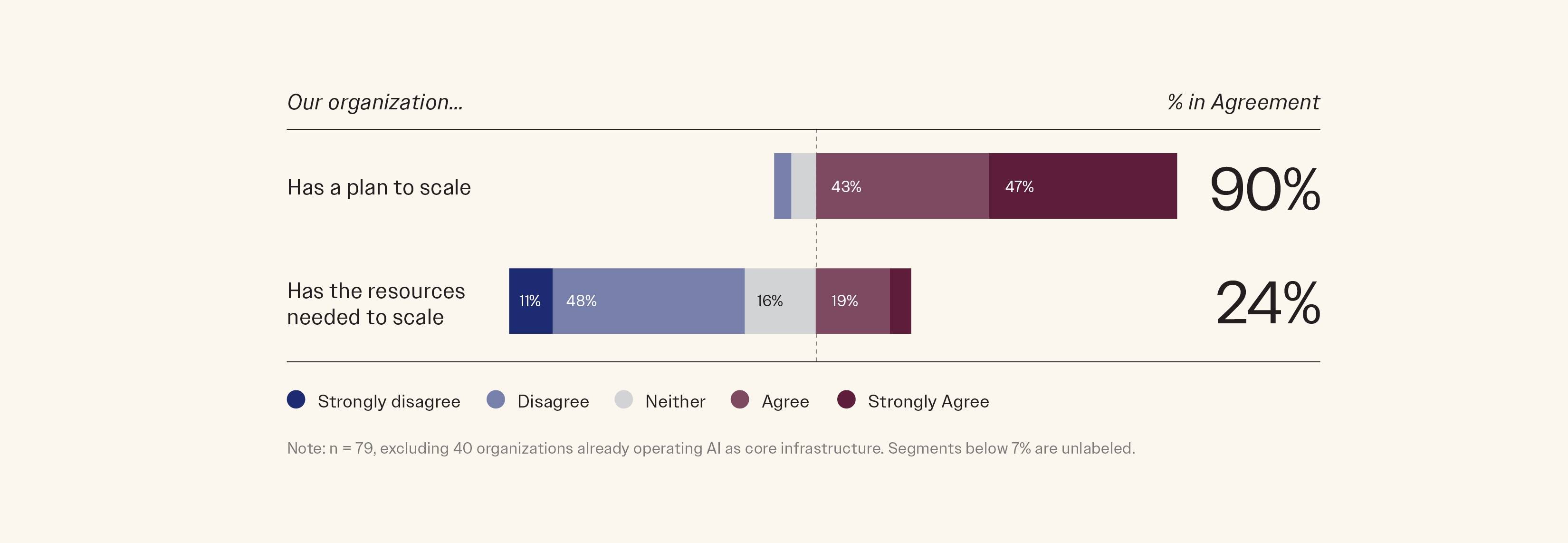
This gap reiterates a catch-22 named in Fast Forward’s 2025 AI for Humanity Report: "needing capital to prove results, but needing proven results to unlock capital." A year later, the catch-22 remains. Pilot money is easier to secure than the larger investments that follow. But the bulk of investments still go to organizations that have demonstrated years of traction. Only a handful of organizations gain the resources to build on early success while the rest remain the size they started.
The wider sector shows the same gap. In NTEN and Bridgespan’s 2026 State of Nonprofit AI Adoption & Governance, 63% of executives report their organization has received no AI-specific funding in any form, and 43% name dedicated funding or grants among the three things that would most help them expand responsible AI use.
Do AI-powered nonprofits think AI is worth the risks?
For the AI-powered nonprofits we surveyed, the benefits of AI outweigh the risks, but that does not mean they dismiss those risks. Not one of the surveyed said AI's risks outweigh its benefits.
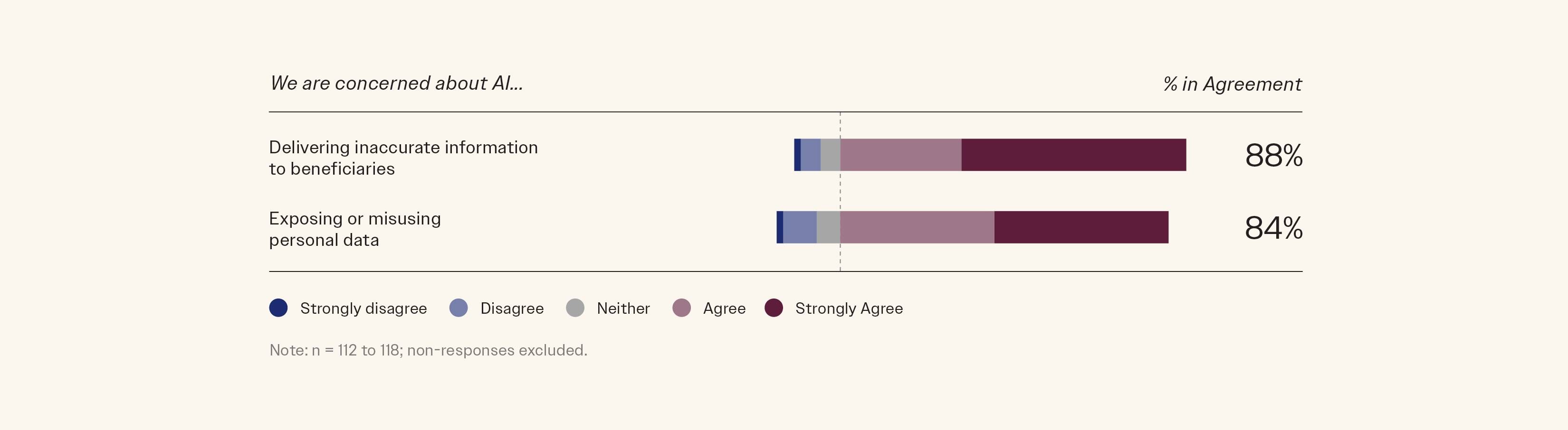
At the same time, respondents see the risks clearly. Most surveyed AI-powered nonprofits say they’re concerned about delivering inaccurate information (88%) and exposing or misusing personal data (84%). To address these risks, they put beneficiaries at the center of how they build. Three-quarters (76%) say they collect ongoing beneficiary feedback, and almost all (85%) say they are very or extremely transparent about their AI use.
New ethical questions come up as the work matures. Gemma Turon, co-founder and CEO of Ersilia, named one: “In our case, where we also teach AI literacy, this comes with another layer of challenge… Do we teach people how to use tools that are proprietary and quite expensive? [...] That's a whole other level of ethical challenges that we are facing this year that we didn't face before."
What can AI-powered nonprofits tell us about the current AI debate?
The AI conversation is increasingly about not only what we can build, but what we should build and how quickly. The 2026 AI for Humanity Report examines a different but related question: how is existing AI being deployed for social impact, by whom, and what values guide the work?
AI-powered nonprofits (APNs) offer one piece of the picture. They are using AI to address real-world problems while remaining accountable to the communities they serve. For APNs, how AI is used matters as much as what it can do. They build around that conviction. Their concerns about AI’s risks coexist with a belief that the technology can help them better serve their communities.
Does AI actually make nonprofits more efficient?
By their own account, yes. Efficiency gains are the most consistently reported benefit among AI-powered nonprofits (APNs). Among those we surveyed:
-
92% say AI made their service delivery more efficient.
-
55% say AI made personalized services at scale possible.
-
41% say AI made delivering services in new languages and formats possible.
-
40% say AI let them reach populations they could not access before.
For many of these APNs, the goal is to do more for the people they already serve. As one nonprofit leader quoted in the report says, “Right now, we are using GenAI to create hyper-personalized content for every student, based on what they’re getting wrong. And it’s not that it would be impossible to do without… But there are many things that would be completely impractical … without GenAI.” That’s the kind of impractical-to-practical shift driving the 92% who report efficiency gains.
For more examples of that shift, read SSIR’s profile on the AI-powered nonprofits reimagining education, written by Kevin Barenblat and Brooke James.
How are nonprofits using AI responsibly?
AI-powered nonprofits (APNs) offer one practical, values-first model for responsible AI adoption: start with the problem, involve the people affected by the tech, and be transparent about how AI is being used.
In our survey, 76% of respondents say they collect ongoing feedback from the people they serve, 51% bring community members into designing or shaping their AI tools, and 85% describe themselves as very or extremely transparent about their AI use. Their reasoning boils down to trust. A lack of public trust ranks as their second-highest external threat (39%). Two-thirds of respondents worry that AI could erode trust with the people they serve. Formal governance structures, however, have not yet caught up with these community-centered habits.
The gap between the two tables is a capacity story. Writing and maintaining AI governance requires staff time and technical expertise. Said differently, managing risks requires funding.
That pattern is not unique to AI-powered nonprofits. In the same NTEN and Bridgespan survey, 39% of executives report written guidance on safe AI use is in place, and 22% report a plan for managing AI-related risks is in place.
How much do AI-powered nonprofits spend on AI?
Most AI-powered nonprofits (APNs) run their AI on modest budgets. 61% of those we surveyed report spending less than $150K a year on AI, combining tools, infrastructure, staff time, and contracts. We interpret this figure as a measure of how early the field is, rather than how much building AI actually costs.
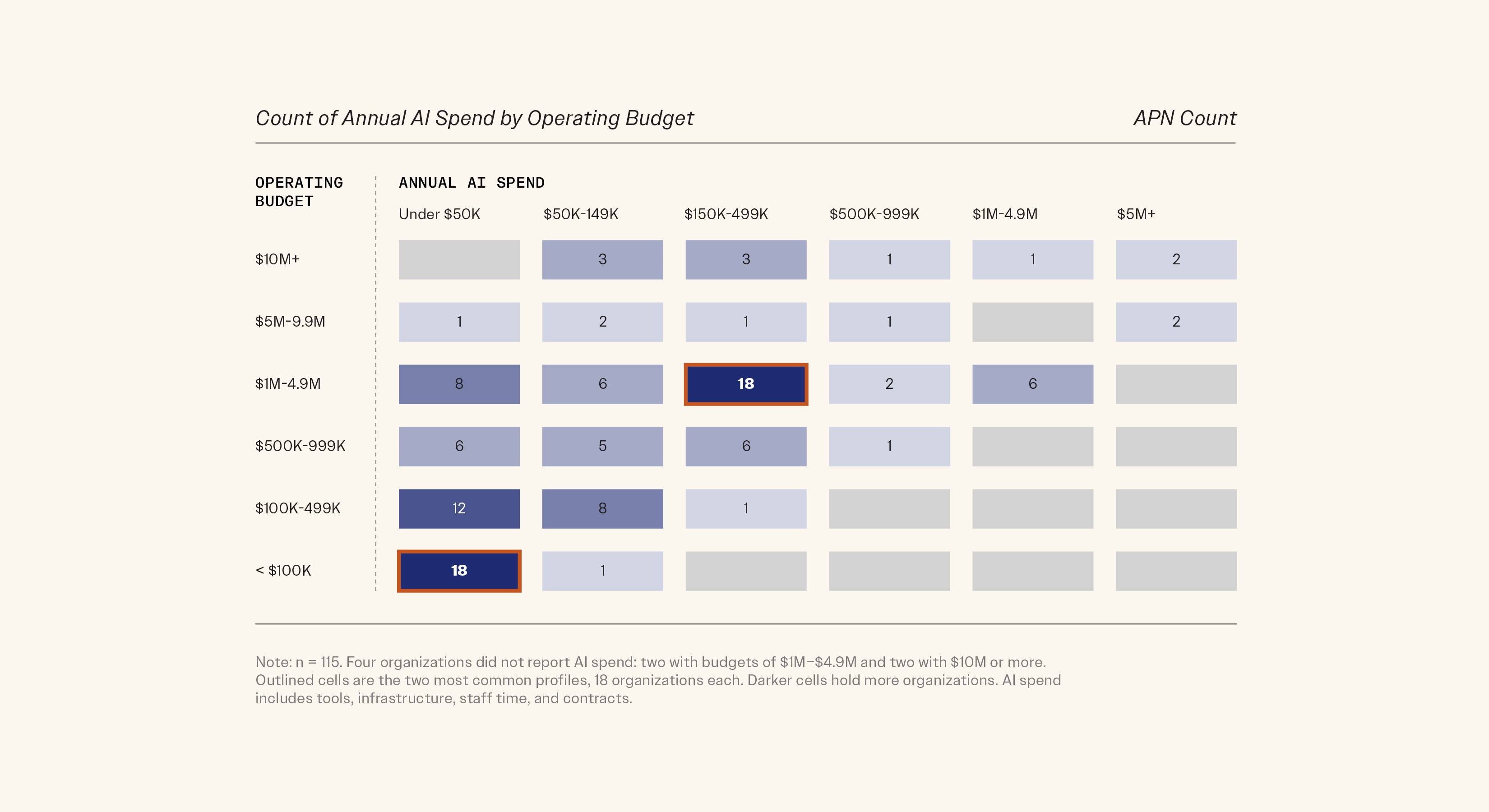
Among those spending under $150K on AI, half say they’re still piloting a solution while a third report they’re already running AI as core infrastructure. The pressure on those budgets is immense. Respondents name the rising cost of AI tools and infrastructure as the single greatest external threat to their work (45%).
What does successful nonprofit AI adoption require?
Successful nonprofit AI adoption starts with people. When asked what enabled AI adoption, 64% of surveyed AI-powered nonprofits (APNs) named a champion who drives the vision, 45% a culture of experimentation and willingness to fail, and 42% curious staff. All three areas depend on people, and people need time to learn and test the tools.
Time is precisely what APNs are struggling with. When APNs were asked to name their biggest internal challenges:
-
39% of respondents chose keeping pace with how fast AI tools and practices change.
-
27% say their team doesn't have the time or capacity to implement AI.
Talent is the other shortage:
-
26% of respondents say they have no technical expertise on staff.
-
Nearly every interviewee described finding and paying for AI talent as a barrier.
The organizations that adopt AI successfully tend to start small and specific. Thirty-nine percent name a clear problem to solve as a top factor in adopting AI. For instance, Adalat AI saw how administrative friction in India’s courtrooms contributed to a huge case backlog. Co-Founder and CEO Utkarsh Saxena says, "Instead of flashy tools, we built a stenography solution that solved a real pain point." Adalat AI’s tools now run in 5,500 courtrooms across 11 states, and TIME named Saxena to its 2026 TIME100 AI list.
How are AI-powered nonprofits funded today?
Project-specific grants are the primary funding source for the report’s respondents (68%). General operating support comes in second at 53%.
AI-powered nonprofits also try to diversify through earned revenue. Twenty-nine percent of respondents name earned revenue among their primary funding sources, and roughly a third want to build a revenue or cost-recovery model. Some leaders told us that charging for their services would work against the communities they serve, so their nonprofits choose philanthropy instead.
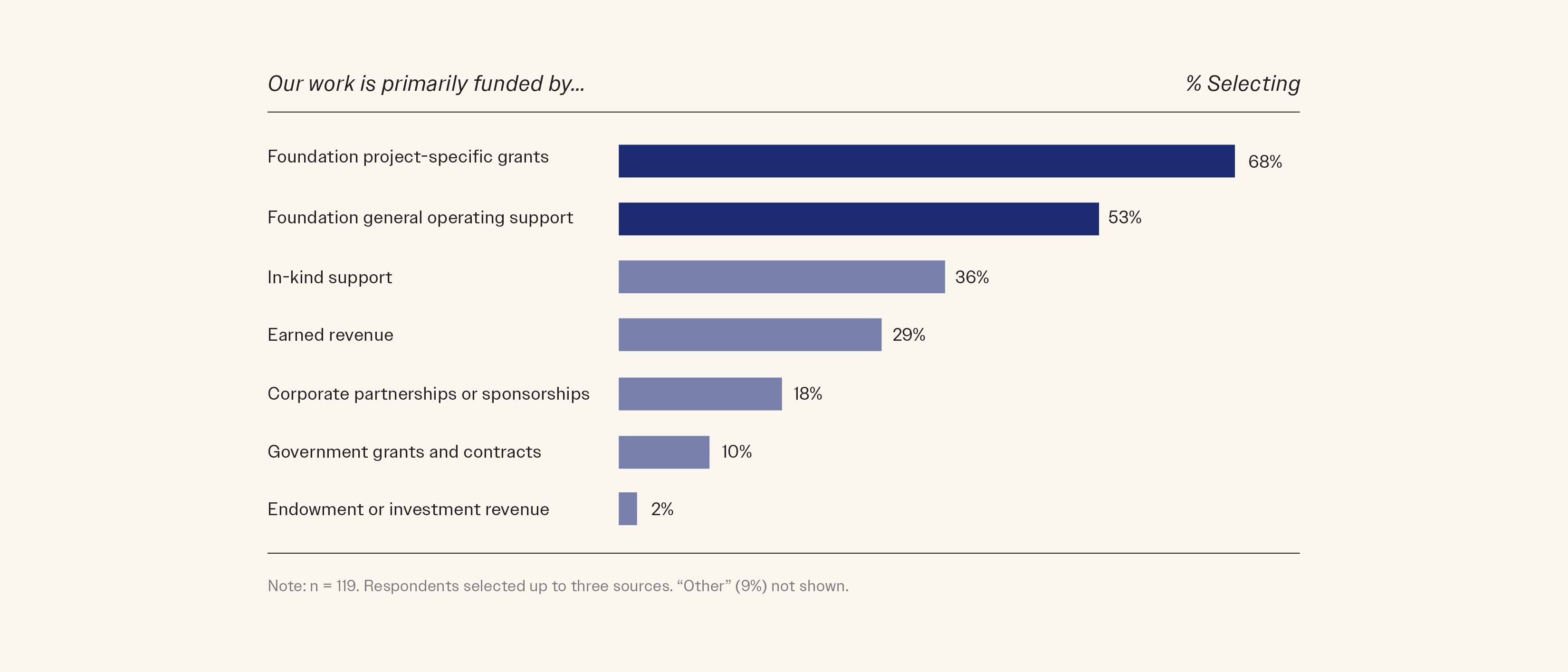
Relying on project grants makes closing this gap in funding difficult. When money is tied to projects, overhead costs to maintain a tool go unaccounted for. Few of these organizations can earn revenue fast enough to cover those costs.
What do AI-powered nonprofits need most?
AI-powered nonprofits need multi-year unrestricted funding. Full stop. When asked what would most help sustain their AI work, 77% of surveyed AI-powered nonprofits named multi-year unrestricted funding as most helpful. This is 31 points ahead of any other answer. When asked what they wished philanthropy would do most, 78% of respondents chose funding long-term infrastructure to successfully scale pilots. Another 47% want funders to take risks on unproven ideas.
The report turns these findings into four recommendations for philanthropy: fund the full lifecycle, fund the people, build capacity for shared commons, and build AI fluency.
Frequently Asked Questions
What is the difference between an AI-powered nonprofit and an AI-assisted nonprofit?
An AI-powered nonprofit directly integrates AI in its product, program, or service. An AI-assisted nonprofit uses AI to support its operations, such as drafting communications or analyzing data. The Playbook on AI for Humanity explains the distinction in full.
Do nonprofits build their own AI or buy it?
Most AI-powered nonprofits build AI on top of what already exists. Among those we surveyed, 72% build their tools in-house on top of existing models or frameworks, about half (55%) customize off-the-shelf tools with their own data, and 44% use off-the-shelf products as-is. Only 27% say they build from scratch, the upside being more control.
What are the biggest risks nonprofits see in using AI?
Nonprofits are most concerned about risks related to the people they serve. In our report, 88% of surveyed AI-powered nonprofits say they’re wary of delivering inaccurate information, 84% about exposing or misusing personal data, and 66% about eroding trust with their communities.
How can AI help nonprofit organizations?
AI can help nonprofits most where the work is too slow or too expensive to do manually. 92% of the AI-powered nonprofits Fast Forward surveyed in the 2026 AI for Humanity Report say AI made their service delivery more efficient, and 55% report AI enabled them to personalize services at scale.
Get the full 2026 AI for Humanity Report
AI-powered nonprofits report that AI is working. What happens next depends on whether philanthropy funds what comes after the pilot. The 2026 AI for Humanity Report is the most comprehensive look at the AI-powered nonprofit landscape. For the complete data, case studies behind the numbers, and recommendations for funders, Explore the full report.
About the research
Fast Forward partnered with Third Plateau to survey 119 AI-powered nonprofits across 20 countries in Spring 2026 and conducted interviews with 20 philanthropic and nonprofit leaders. The findings are self-reported and do not generalize to the nonprofit or philanthropy sectors. The report was produced with support from Google.org. For more details, read the full methodology.
Suggested citation. Bitner-Laird, L., Wrenn, J., Cavalier, T., Nelson, K., & Davenport, N. (2026). 2026 AI for Humanity Report. Fast Forward. https://www.ffwd.org/ai-for-humanity-report
Next Steps
Go Deeper on the 2026 Findings
Walk through the data from the report with the people behind it. One session is a roadmap for philanthropy, the other a roadmap for builders.

One place for everything we publish on AI-powered nonprofits: research, blogs, news, and the stories of the builders shaping the movement.

Stay up to date on the latest in AI-driven social impact. Your monthly guide to the world of AI-powered nonprofits, written by Kevin Barenblat.